


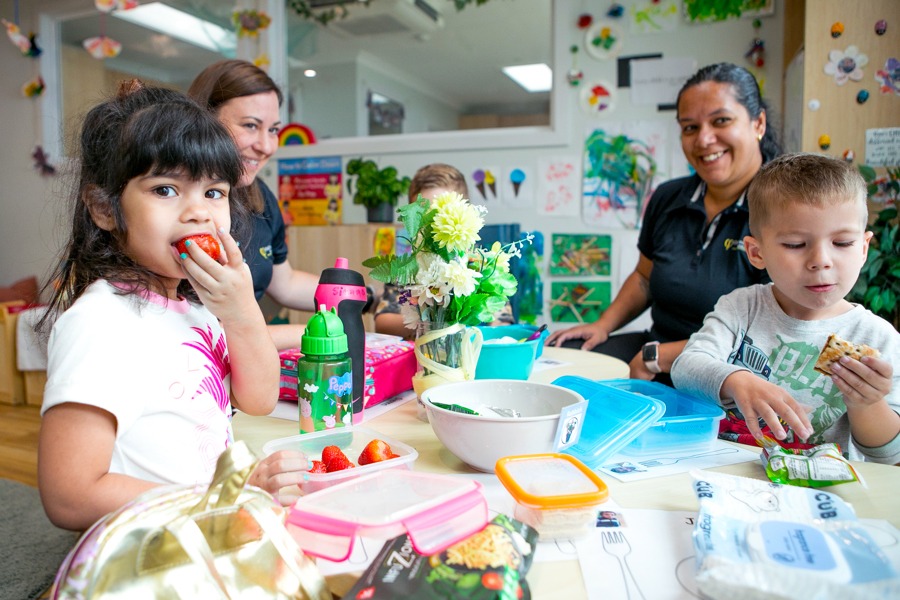
Key takeaways
- A comfortable, well-supported seat helps your child focus on eating.
- Predictable mealtimes and clear cues help your child know what’s coming.
- Eat together, talk about food without judging it, and never force a food.
- Touching or smelling a new food is real progress. It can take 10 to 15 tries, or more, to accept a new food.
- If your child eats a very small range of foods or mealtimes are always a battle, get support.
Where do you start? Mealtimes can be stressful in any family. Here are ten practical tips our occupational therapists share with families to make mealtimes calmer and more positive for everyone.
Set up for success
1. Get the seating right. Your child focuses on eating best when their body feels stable. Check the chair and table suit their size: feet supported (flat on the floor or on a footrest), hips and knees bent at about right angles, and the table at about elbow height.
2. Use clear mealtime cues. A placemat, plate and cup on the table tell your child “it’s mealtime” without words.
3. Give a warning. “Five minutes until lunch.” A heads-up helps your child finish what they’re doing and get ready.
Build a predictable routine
4. Keep meals and snacks at similar times each day. For example, breakfast at 8, morning tea at 10, lunch at 12, afternoon tea at 3 and dinner at 6. Predictable times help your child’s body expect food and help them know what’s coming.
5. Show the food. If your child won’t come to the table, showing them the food can help them see it’s mealtime.
At the table
6. Make it a positive place to be. If your child won’t sit, try bringing a favourite small activity to the table alongside the meal. Activities with a clear end work best, such as bubbles. The aim is for the table to feel fun and relaxed.
7. Eat together. Sit with your child and eat the same foods where you can. Children learn by watching you.
8. Talk about food without judging it. Describe what you notice: “It’s green!” “It’s crunchy! Listen!” Try not to label foods as “yummy” or “yucky”, or as “good” or “bad”.
New foods
9. Celebrate small steps. For a child who eats a limited range of foods, touching, smelling or licking a new food is real progress. These steps come before eating it. Offer a small amount of a new food next to a familiar favourite, and keep offering it: it can take 10 to 15 tries, or more.
10. Keep it calm and pressure-free. Never force your child to eat. Keep meals to about 20 minutes, then clear the plates without comment. A calm, fun mealtime does more for eating than any amount of pressure.
When to seek support
Talk to your GP, child and family health nurse or a dietitian if your child:
- eats a very small range of foods, or refuses whole food groups for more than a few weeks
- isn’t growing or gaining weight as expected
- often gags, coughs or chokes when eating or drinking
- has mealtimes that are distressing for them or the family most days
Some children find the textures, smells or sounds of food overwhelming, or struggle with the sitting, chewing or utensil skills eating needs. Our occupational therapists in Northmead can look at the sensory and self-care sides of mealtimes and help you build a plan for home. We support NDIS self-managed and plan-managed families; see our funding options or contact our Northmead team.
Frequently asked questions
How many times should I offer a new food?
Keep offering it in small amounts alongside foods your child likes. It can take 10 to 15 tries, or more, before a child accepts a new food.
Should I make my child sit at the table until they finish?
No. Keep meals to about 20 minutes, never force eating, and clear the food without comment. Pressure usually makes fussy eating worse.
Is it okay to bring a toy to the table?
For a child who finds sitting at the table hard, a small activity can help the table feel positive. Choose something with a clear end, like bubbles, and phase it out as mealtimes get easier.
When is fussy eating more than a phase?
If your child eats very few foods, avoids whole food groups for more than a few weeks, isn’t growing as expected, or often gags or chokes, talk to your GP.
Can an occupational therapist help with fussy eating?
An OT can help with the sensory, seating, routine and self-care parts of mealtimes. Your GP can also refer you to a dietitian or speech pathologist where needed.
References
- Raising Children Network. Fussy eating in toddlers.
Updated from an earlier article by Nicola Hayes.
Related reading: Sensory Processing · Toileting & Self-Care OT · Supporting transitions · Occupational Therapy