


Key takeaways
- Children learn language best in everyday moments with the people they love, not only in sit-down lessons.
- Follow your child’s interest, copy what they do, and join in.
- Be your child’s “commentator”: describe what’s happening in short, simple words.
- Keep your sentences just a little longer than your child’s.
- Turn routines like dressing and meals into small games, and leave a pause for your child to show what they know.
When most children are curious, they ask questions: “Why is the sky blue?” “Why do fish live in the sea?” Some children, including many autistic children and late talkers, show their curiosity in other ways. That’s just as rich a starting point for learning.
Curiosity can look different
Instead of asking “Why is paper so light?”, your child might grab a handful of shredded paper, throw it in the air and let it fall on their head. They’re exploring with their senses.
You can help them make sense of what they’re exploring by adding words to the moment.
Step 1: Join in and copy
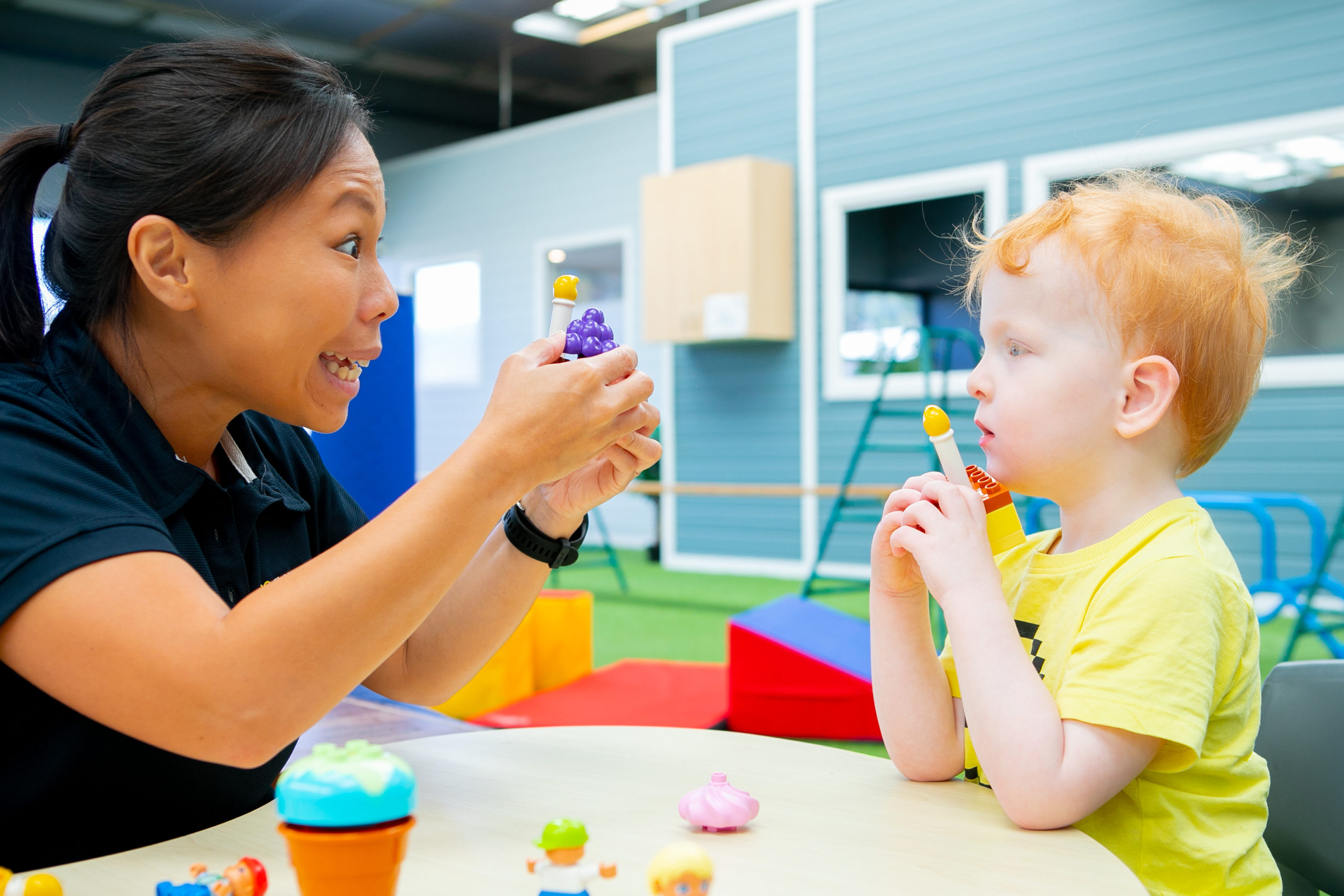
Copy exactly what your child is doing. Throw the paper up too. Then add a little something to make it a game:
- “Ready, set… go!” before the paper falls
- more paper and less paper
- falling fast and falling slowly
Copying shows your child you value their ideas. Once they see you’re part of their game, they’re much more open to your ideas too.
Step 2: Be your child’s commentator
Describe what’s happening, like a sports commentator, using short, simple words: “Paper falling.” “Lots of paper.” “White paper.”
This gives your child more words to understand and, over time, to use. Keep it simple and repeat the same words. Predictable language helps your child learn what comes next. After a while, you might say “Shirt…” and your child fills the gap: “On!”
Tip: keep your comments just a little longer than your child’s own talking. If your child uses single words, comment with two or three words (“shirt on”). If they use short phrases, try simple sentences (“Your shirt is on”).
Step 3: Turn everyday routines into games
Dressing, bath time and meals happen every day, which makes them perfect for practice. For example, while dressing:
- Hold up the shirt and say “Shirt on… head?” while placing it on your own head, with a puzzled face.
- Wait. Your child might look at you, laugh, shake their head or pull the shirt off.
- Respond to whatever they do: “Not on head! Where does it go?”
- Give your child the chance to show you: they might lift their arms, or bring the shirt to their body.
Three things make this work:
- Join in and copy what your child is doing.
- Make it fun or silly, so your child wants to look at you.
- Pause and wait, so your child has a turn to show what they can do.
Over time, your child takes a bigger part in everyday routines. That builds language and independence at the same time.
When to seek support
Talk to a speech pathologist if your child:
- isn’t using words by around 18 months, or isn’t joining two words by 2
- doesn’t often look at you, point or use gestures to share interest
- seems to understand much less than other children their age
- is frustrated because they can’t get their message across
Our speech pathologists in Northmead use play-based sessions and parent coaching, so you leave with ideas like these to use at home. We support late talkers, children with language difficulties and autistic and neurodivergent children across Western Sydney. We support NDIS self-managed and plan-managed families; see our funding options or contact our Northmead team.
Frequently asked questions
What is a teaching moment for a toddler?
Any everyday moment where you add words or a small challenge to what your child is already doing: dressing, bath time, meals or play. Short, frequent moments add up.
What does “commenting” mean?
Commenting is describing what’s happening in simple words (“ball rolling”, “big splash”) without asking questions or expecting an answer. It gives your child words without pressure.
How long should my sentences be when talking to my toddler?
Just a little longer than your child’s. If they use single words, use two or three words. If they use short phrases, use simple sentences.
Do these ideas work for autistic children?
Yes. Following your child’s lead, copying their play and using simple, predictable words suit many autistic children. A speech pathologist can tailor them to your child.
References
- Raising Children Network. Autistic children: paying attention.
- Raising Children Network. Toddler talking and communication.
Updated from an earlier article by Lauren Chang.
Related reading: Echolalia, Part One · Imitation through song · Generalisation · Speech Therapy