

Key takeaways
- Imitation (copying actions, sounds and words) is one of the main ways children learn new skills, including talking.
- Action songs are fun, predictable and rhythmic, which makes them a great way to practise imitation.
- Be animated, repeat the same songs often, and let your child learn a song before expecting them to join in.
- Once a song is familiar, pause before the next action and wait for your child to fill the gap.
- Any response counts: a look, a sound, a gesture or an action.
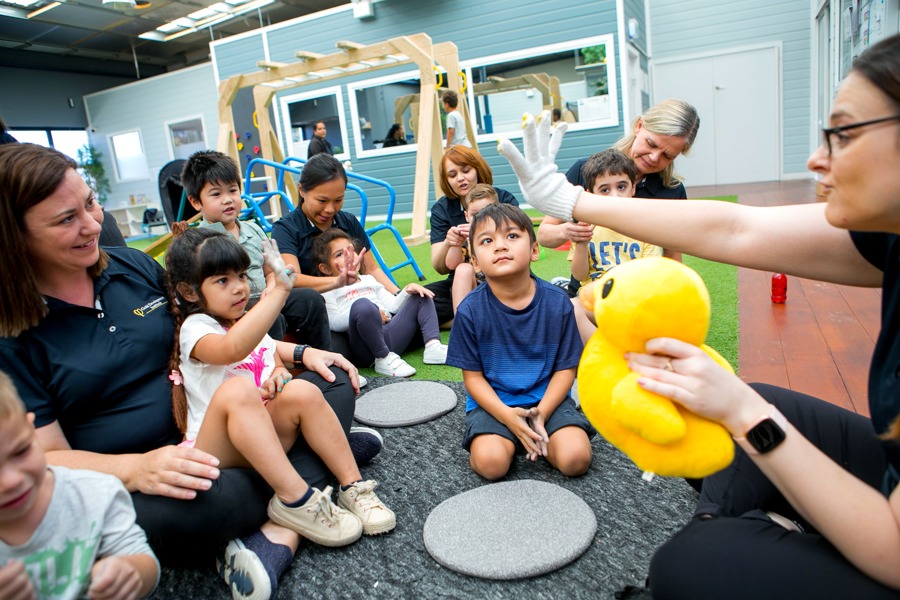
Music is naturally motivating. It’s fun, it’s predictable and it has rhythm. Action songs in particular are one of the easiest ways to help your child look at you, join in and copy what you do.
Why does imitation matter?
Imitation is how children learn so much: waving bye-bye, clapping, stacking blocks, and saying their first sounds and words. Before a child copies words, they usually copy actions and sounds.
Some children, including many autistic children, find imitation harder. For them, motivating, playful practice is even more important.
Why do songs work so well?
- They’re predictable. The same words and actions come in the same order every time, so your child learns what comes next.
- They build shared attention. Singing together face to face encourages your child to look at you and share the moment.
- They practise lots of skills at once: body actions, sounds, words, and face and mouth movements like poking out a tongue or blowing raspberries.
How to use action songs
- Be animated. Exaggerate the actions, your facial expressions and sound effects. Change your voice to suit the song. Be silly! This makes your child want to watch and join in.
- Repeat, repeat, repeat. Sing the same few songs often so they become familiar.
- Let your child learn the song first. Especially with a new song, sing it many times before you expect your child to copy you.
- Make songs part of your routine. Before meals, at nappy changes, at bedtime, after a story or during play.
The pause-and-wait routine
Once your child knows a song well, pause just before a familiar action or word. Give them an expectant look and wait. Your child might:
- look at you, or make a sound or gesture to ask you to keep going
- do the next action
- say or sing the next word or sound
All three are wins. Respond straight away by carrying on with the song, so your child learns that joining in keeps the fun going. For example, in “Heads, Shoulders, Knees and Toes”, stop with your hands in the air before “toes” and wait.
10 action songs to try
- Heads, Shoulders, Knees and Toes
- If You’re Happy and You Know It
- Baby Shark
- Five Little Monkeys
- Five Little Ducks
- The Wheels on the Bus
- The Hokey Pokey
- Open Shut Them
- Row, Row, Row Your Boat
- Twinkle Twinkle Little Star (with hand actions)
When to seek support
Talk to a speech pathologist if your child:
- rarely copies actions, sounds or gestures by around 12 to 18 months
- doesn’t often look at you or share attention during play
- isn’t using words by around 18 months
- has lost words or skills they used to have
Our speech pathologists in Northmead use play, songs and parent coaching to support late talkers and autistic and neurodivergent children across Western Sydney. We support NDIS self-managed and plan-managed families; see our funding options or contact our Northmead team.
Frequently asked questions
Why are action songs good for toddlers?
They’re fun and predictable, and they give children lots of chances to watch, copy and join in. That practises imitation, attention and early language all at once.
At what age do children start imitating?
Babies begin copying faces and sounds in their first year, and toddlers copy more actions and words through their second year. Every child develops at their own pace.
My child doesn’t join in. Should I keep singing?
Yes. Keep singing the same songs, keep it fun, and pause to give your child a chance. Watching and listening is part of learning, and joining in often comes later.
Can music help autistic children with communication?
Many autistic children enjoy music, and songs’ predictability can make it easier to join in. A speech pathologist can help you use songs to target your child’s communication goals.
References
- Raising Children Network. Play ideas for toddler language and talking.
- Raising Children Network. Autistic children: paying attention.
Updated from an earlier article by Gabby Castellarin.
Related reading: Onomatopoeia · Everyday teaching moments · Finding your child’s smile during play · Speech Therapy